Case study · palimpsest interpretive engine v7 (known-layer conditioning, dropout-regularized) + remnant projection · updated 2026-08-20
A damaged macropod, completed as a hypothesis
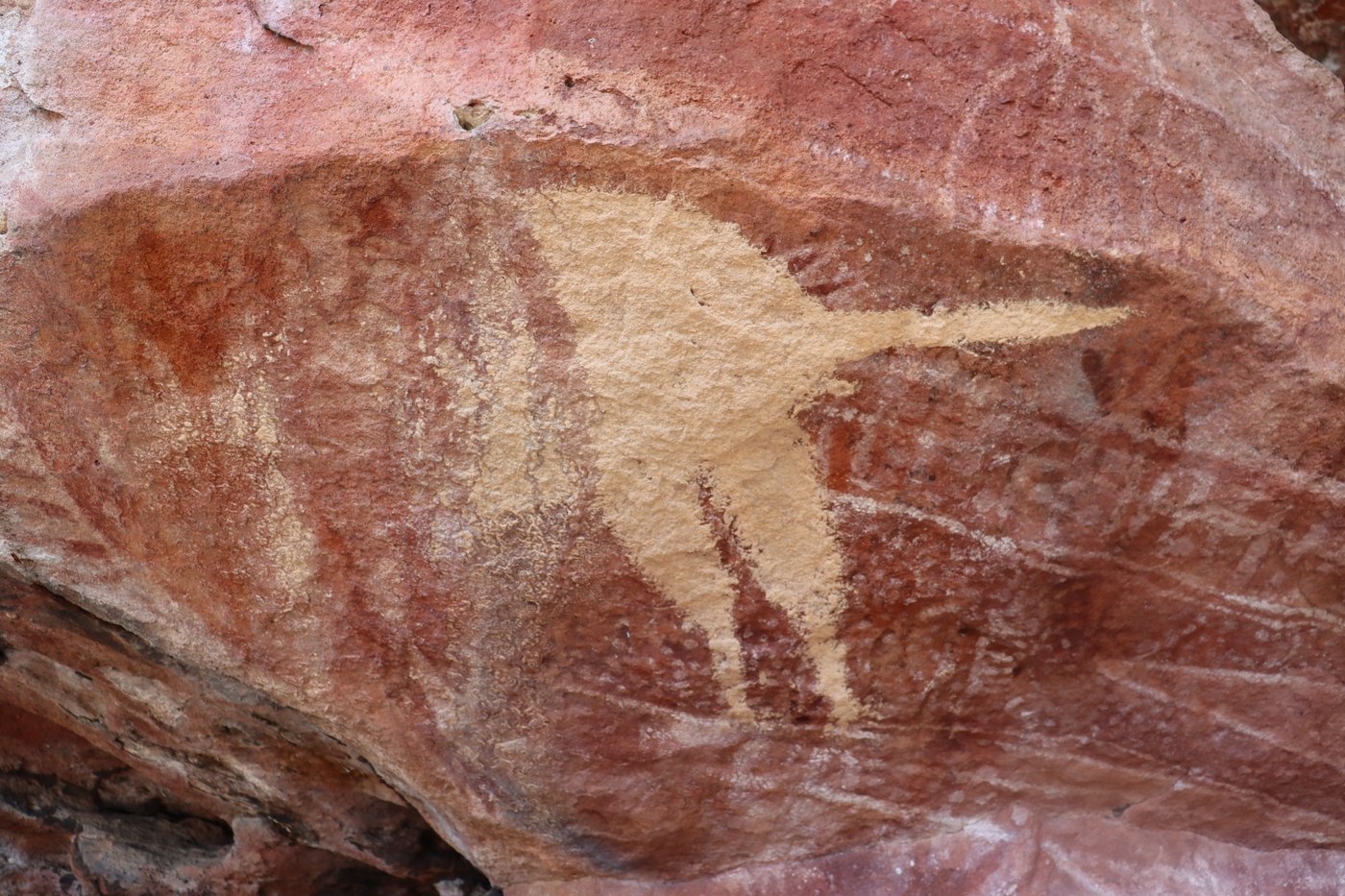
The panel below carries a large macropod in pale pigment, facing left: the body, tail and hind legs survive; the head, chest margin and forelegs are lost to surface damage on the left. It is a well-posed instance of the question this workbench's interpretive engine exists to answer — what did the whole figure most plausibly look like, and where is any reconstruction guessing?
Method
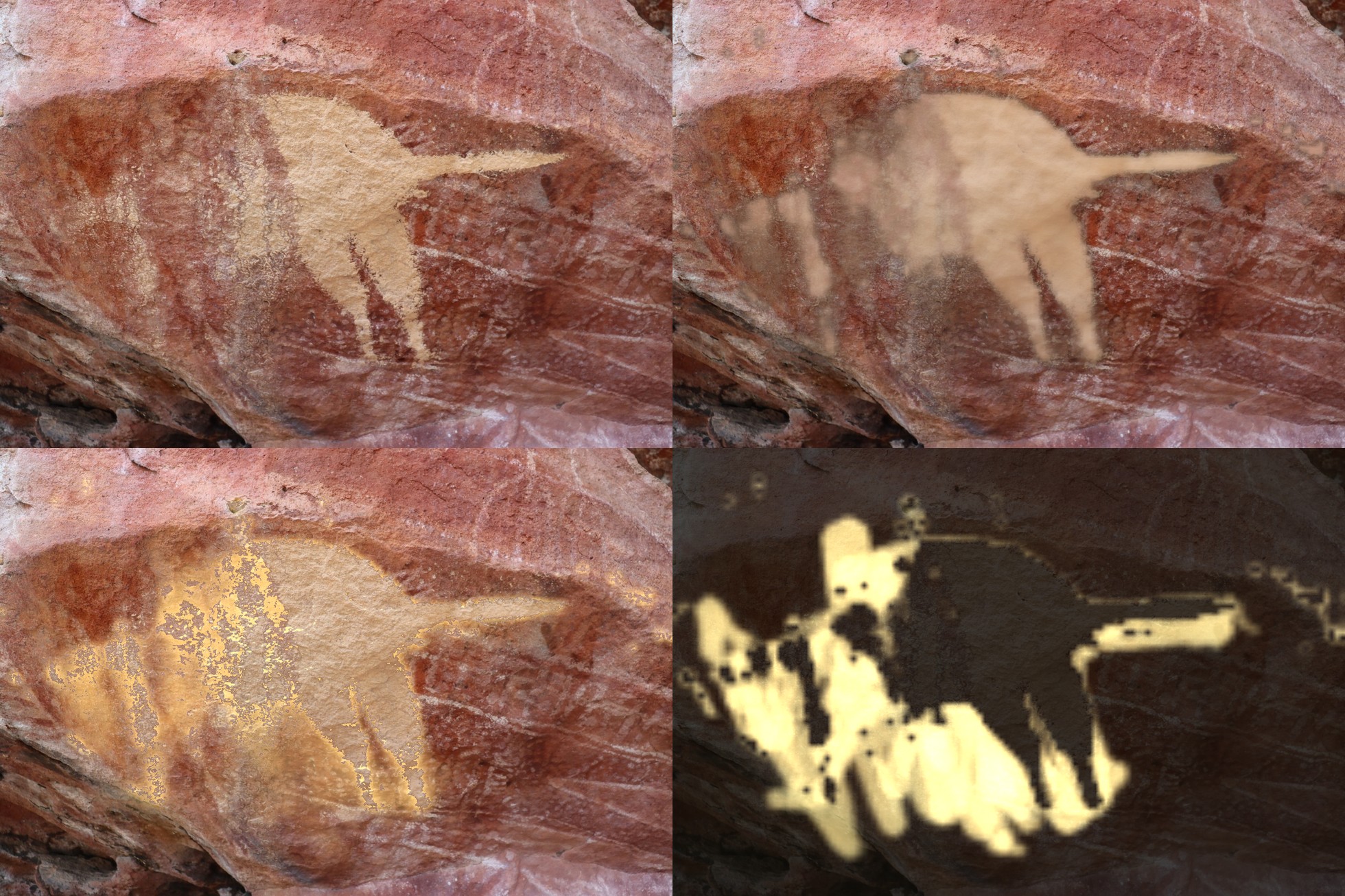
The figure's surviving pigment was selected by sampled-colour segmentation over the entire uncropped frame (Lab colour distance from sampled pigment; ~15% of the frame joins the remnant). That whole remnant then conditioned a diffusion completion model, sampled eight times; the per-pixel mean is the reconstruction and the per-pixel disagreement is its uncertainty. Non-square frames are reflection-padded rather than cropped, so no edge of the panel is excluded. The model (v6) learned restoration self-supervised from this corpus' own marks: real pigment segments, composited onto real bare-rock texture and synthetically damaged, with the undamaged real layer as ground truth — no hand-designed shape vocabulary anywhere in the completion path, so nothing about the method is specific to known figure types.
Reading the result — honestly
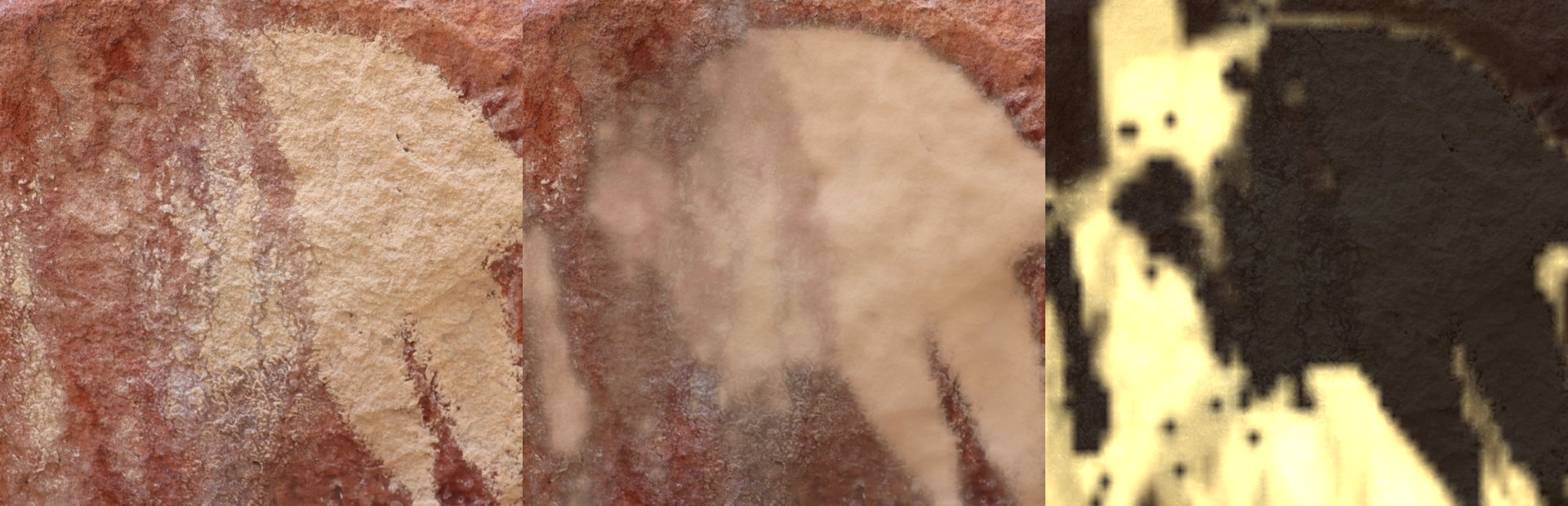
What worked. The figure is completed as a single animal: interior damage streaks are healed, the tail and legs are bound to the body, and the reconstruction extends into the damaged left side along surviving traces, proposing the chest line and a compact head-side mass — with the uncertainty map brightest precisely over those inventions. An earlier revision of this analysis failed to reach the head zone at all; the cause was embarrassingly literal — the pipeline's centre-crop had cut that part of the photograph out of the model's view.
What still falls short. The head-side extension is a mass, not an articulated head with ears. On held-out panels the completion arc is measured, not felt: hidden-region overlap 0.137 (v3 alone) → 0.255 (+remnant projection) → 0.272 (v6, which takes the surviving layer as input rather than re-deriving it) → 0.277 (v7) — doubled in three revisions — but inferring shape far beyond any surviving trace remains the open frontier. The model proposes that the figure continues leftward more confidently than what exactly it looked like — which is where an honest instrument should stop.
Why this is the right failure mode. A tool that confidently paints a head with no surviving trace would be a hallucination engine. This one extends where evidence leads, abstains where it does not, and quantifies the difference.
Everything on this page is a labelled hypothesis from an interpretive model — not evidence of what is on the rock, and not a restoration. The analytical record is the photograph. Rock art imagery may be culturally significant; this page is published by the photographer, and enhanced or reconstructed imagery of other sites should not be published without consulting their custodians.
palimpsest v7 · trained on real pigment segments from this corpus (self-supervised, vocabulary-free) · decomposer step 87000 (256px) · restorer step 320000 (128px, known-layer conditioned) · 8 samples · 40 DDIM steps · remnant projection · ΔE76 remnant selection